Marrakech vs Fes: Which Moroccan City Should You Visit First?
Trying to choose between Marrakech and Fes? Discover the differences, highlights, costs, atmosphere, and best itinerary order for your first Morocco trip with MSITravels.
Marrakech and Fes are Morocco’s two greatest imperial cities, yet they offer completely different introductions to the country. Marrakech is colorful, theatrical, energetic, and easier for first-time visitors to understand. Fes is older, deeper, more traditional, and more complex — a city that rewards patience, curiosity, and a good local guide. For most first-time travelers to Morocco, MSITravels recommends starting in Marrakech and ending in Fes. Marrakech gives you the rhythm, confidence, and cultural context you need; Fes then reveals Morocco at its most historic, intellectual, and unforgettable.
Choosing between Marrakech and Fes is one of the most common questions travelers ask when planning a Morocco tour. Some visitors have only a few days and want to know which city deserves priority. Others are planning a 7-day, 10-day, or 12-day itinerary" class="msi-auto-link">Morocco itinerary and wonder whether both cities should be included. Many travelers have seen photos of Marrakech’s rooftop restaurants, riads, spice stalls, and famous Djemaa el-Fna square, but they have also heard that Fes is Morocco’s spiritual and cultural soul.
The truth is simple: Marrakech and Fes are not interchangeable. They do not offer the same experience with different scenery. They represent two different faces of Morocco.
Marrakech is the Morocco of movement, performance, color, hospitality, design, gardens, nightlife, and easy visual beauty. It is the city that welcomes visitors with energy and confidence. It knows how to receive travelers. Its tourism infrastructure is strong, its international flight connections are excellent, and its range of riads, restaurants, guides, shops, hammams, museums, and day trips makes it a natural first stop.
Fes is the Morocco of memory, scholarship, craft, religion, architecture, and living heritage. It is less polished, less theatrical, and sometimes more demanding. But for travelers who want to feel the weight of Moroccan history, few places in the world compare. Fes is not simply a city you visit; it is a city you enter slowly, with respect, attention, and ideally with a licensed local guide who can help you understand what you are seeing.
At MSITravels, we do not believe travelers should choose one city because the other is “better.” The better question is: which city should you visit first, and how should you experience each one?
For most first-time Morocco travelers, the best answer is Marrakech first, Fes second.
Marrakech helps you adjust to Morocco. Fes helps you understand it.
Marrakech and Fes: Two Imperial Cities, Two Different Worlds
Both Marrakech and Fes are imperial cities, meaning both have served as capitals of Moroccan dynasties and both hold deep historical significance. Yet their personalities are very different.
Marrakech sits in the south-central part of Morocco, near the foothills of the High Atlas Mountains. It has long been a gateway between the Sahara, the mountains, and the Atlantic routes. The city is warm, dramatic, and open to influence. It has always attracted merchants, artists, designers, travelers, and dreamers. Today, it is Morocco’s most internationally famous city and the one most visitors imagine before arriving.
Fes, located in northern inland Morocco, is older in atmosphere and more inward-looking. It is often described as Morocco’s spiritual, intellectual, and cultural capital. Its ancient medina, Fes el-Bali, is one of the most remarkable urban spaces in the world. Unlike Marrakech, which often performs itself for visitors, Fes feels less concerned with pleasing tourists. It continues its own rhythm. The medina is not a stage; it is a living system.
This difference affects the traveler experience immediately.
In Marrakech, you may feel excited, stimulated, and visually overwhelmed, but the city offers many ways to relax and reset. You can return to a quiet riad courtyard, enjoy a rooftop dinner, visit a garden, take a cooking class, book a hammam, or spend an afternoon in a boutique hotel pool. Marrakech can be intense, but it is also highly manageable.
In Fes, the experience is more immersive. The medina is larger, denser, and more difficult to navigate. The alleys twist in ways that can confuse even experienced travelers. The city demands focus. But if you give Fes time, it rewards you with something rare: the feeling of entering a medieval urban world that is still alive.
Marrakech seduces quickly. Fes reveals itself slowly.
Why MSITravels Usually Recommends Visiting Marrakech First
For first-time visitors, Marrakech is the best introduction to Morocco because it offers cultural intensity with enough comfort and structure. It gives travelers the colors, sounds, tastes, architecture, and atmosphere they came for, while also providing the practical support that makes arrival easier.
Many international travelers arrive in Morocco after a long flight from the USA, Canada, the UK, Europe, or Australia. On the first day, they need a city that can welcome them without immediately exhausting them. Marrakech does this well. The airport is close to the city, the riads are experienced in receiving international guests, and the medina offers an exciting but relatively accessible first experience.
Marrakech also helps travelers develop confidence. After one or two days, you begin to understand the rhythm of Moroccan streets, the etiquette of bargaining, the role of a guide, the structure of a medina, the beauty of riad architecture, the flavors of Moroccan cuisine, and the importance of slowing down. This knowledge becomes extremely useful later in Fes.
Fes is extraordinary, but it can be too much as a first contact for some travelers. The medina is deeper, older, more complicated, and less visually organized. If you arrive in Fes without any context, the experience can feel confusing rather than magical. You may see the tanneries, madrasas, mosques, markets, and craft workshops, but without understanding the layers, it can become a blur.
Starting in Marrakech gives you a foundation. By the time you reach Fes, you already understand what a souk is, how a riad works, why Moroccan craftsmanship matters, how to move through narrow streets, and why a local guide can transform the experience. You are no longer simply reacting to Morocco. You are reading it.
That is why many MSITravels itineraries are designed with a natural progression: Marrakech, High Atlas Mountains, Ait Benhaddou, Sahara Desert, Ziz Valley or Midelt, then Fes. This route allows travelers to move from the colorful energy of Marrakech into the landscapes of the south, through desert culture, and finally into the deep historical atmosphere of Fes.
The journey becomes a story, not just a route.
Marrakech: Morocco’s Most Iconic City
Marrakech is the city of first impressions. It is the red walls, the palm-lined avenues, the hidden riad courtyards, the scent of spices, the sound of drums at night, and the glow of lanterns above rooftop terraces. It is also the city that has done the most to shape Morocco’s global image.
For many travelers, Marrakech feels like a dream they have already seen in photographs — but the real city is more intense, more layered, and more human than any image can show. The beauty of Marrakech is not only in its monuments. It is in the movement between them: a doorway opening into a silent courtyard, a donkey cart passing a luxury boutique, a call to prayer above traffic, a brass lamp maker working beside a modern café.
Marrakech is often described as chaotic, but that word alone is too simple. The city has its own rhythm. It is lively, expressive, commercial, and social. People talk, sell, negotiate, guide, cook, perform, repair, carry, invite, and move. At first, it can feel like too much. Then, with a good guide and a little patience, the rhythm begins to make sense.
The heart of Marrakech is the medina, a UNESCO-listed historic district surrounded by old red walls. Inside, travelers find souks, mosques, palaces, fondouks, hammams, food stalls, gardens, museums, and thousands of small details. Outside the medina, the modern city offers galleries, restaurants, hotels, nightlife, and easy access to the High Atlas Mountains.
Marrakech is ideal for travelers who want a strong, beautiful, energetic introduction to Morocco without feeling too far from comfort.
Top Things to See and Do in Marrakech
Djemaa el-Fna
Djemaa el-Fna is the famous main square of Marrakech and one of the most memorable public spaces in North Africa. During the day, it is busy with juice stalls, musicians, vendors, and movement. At night, it transforms into a huge open-air theater of food stalls, storytellers, performers, drummers, and crowds.
For first-time visitors, Djemaa el-Fna can be thrilling and overwhelming. It is best experienced with awareness and confidence. A guided orientation helps travelers understand how to move through the square, where to eat, how to handle persistent approaches, and where to find the best rooftop views.
The square is not a museum. It is alive, commercial, imperfect, noisy, and unforgettable. For many travelers, this is where Morocco first becomes real.
The Souks of Marrakech
The souks of Marrakech are among the most famous markets in the world. They spread through the medina in a maze of lanes dedicated to spices, leather, metalwork, lamps, carpets, ceramics, slippers, textiles, woodwork, and traditional crafts.
Shopping in Marrakech is not only about buying. It is about seeing the relationship between craftsmanship, design, negotiation, and daily life. Some travelers love the bargaining process; others find it stressful. A good guide can help you distinguish between tourist-oriented shops and more serious artisan spaces.
The Marrakech souks are colorful and photogenic, but they are also commercial. This is part of their energy. They are designed to attract attention and invite exchange. For travelers who enjoy design, craft, and atmosphere, they are a highlight.
Bahia Palace
The Bahia Palace is one of Marrakech’s most beautiful historic buildings. Built in the 19th century, it showcases Moroccan decorative arts through carved cedar, painted ceilings, marble courtyards, zellige tilework, and peaceful garden spaces.
The palace offers a strong introduction to Moroccan architecture. It helps travelers understand how beauty in traditional Moroccan design often faces inward. From the outside, many buildings are plain. Inside, they open into courtyards, fountains, light, and intricate craftsmanship.
Visiting Bahia Palace early in the day is usually best, before the crowds become heavy.
Koutoubia Mosque
The Koutoubia Mosque is the most recognizable landmark in Marrakech. Its minaret rises above the city and serves as a visual anchor for the medina. Non-Muslims cannot enter the mosque, but the exterior and gardens are worth visiting, especially near sunset.
The Koutoubia also helps travelers understand the central role of Islamic architecture in Moroccan urban life. It is not only a monument; it is part of the daily soundscape and spiritual rhythm of the city.
Majorelle Garden and Yves Saint Laurent Museum
The Majorelle Garden is one of the most visited places in Marrakech. Created by French painter Jacques Majorelle and later restored by Yves Saint Laurent and Pierre Bergé, the garden is known for its cobalt blue buildings, desert plants, palms, bamboo, and calm atmosphere.
Nearby, the Yves Saint Laurent Museum connects Marrakech to the world of fashion, design, and international artistic influence. Together, the garden and museum show another side of the city: Marrakech as a place that has inspired artists, designers, and collectors for generations.
Tickets should be booked in advance, especially during busy seasons.
Rooftop Dining and Riad Life
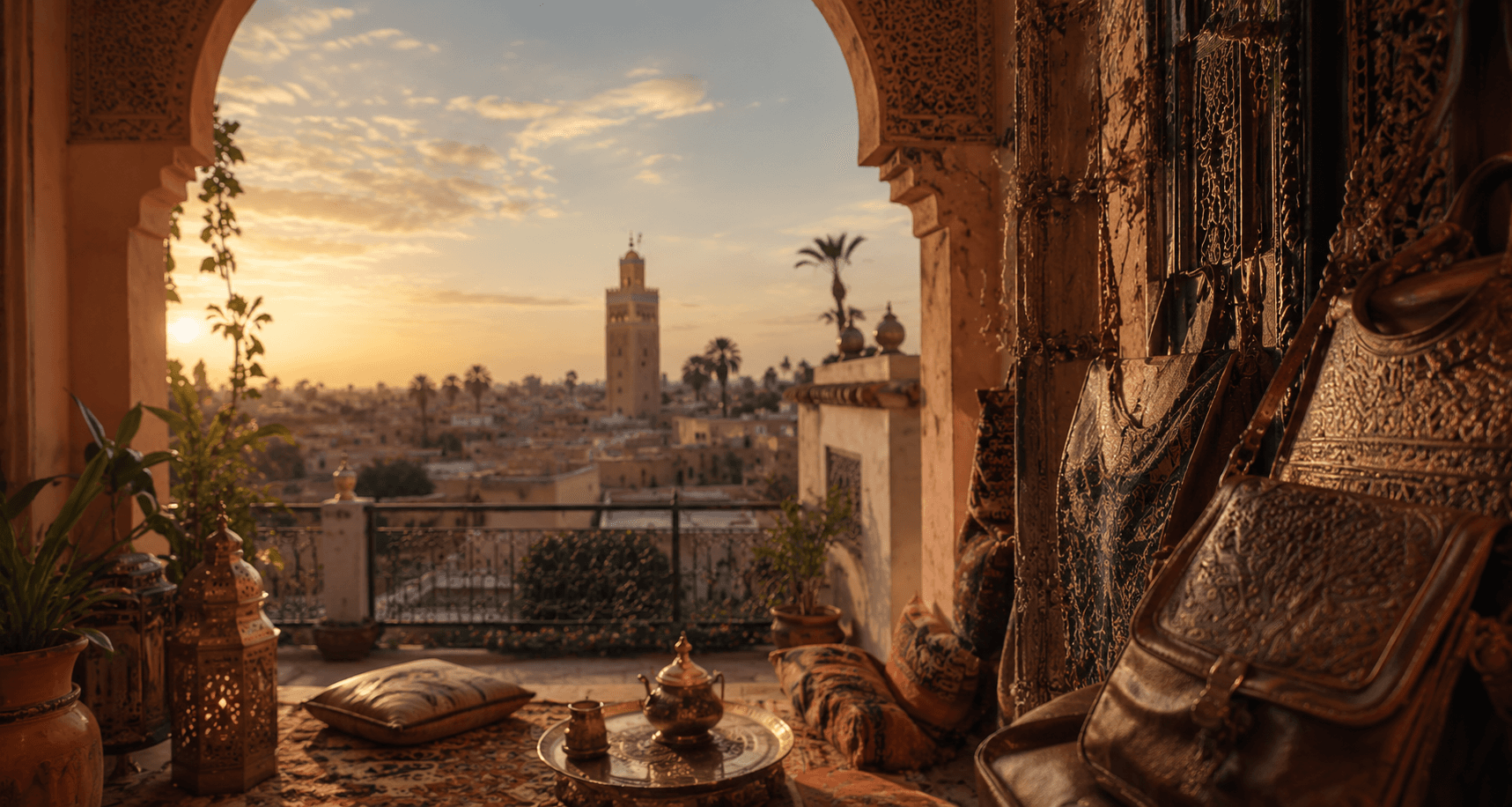
One of Marrakech’s greatest pleasures is simply staying in a riad. A riad is a traditional Moroccan house built around an interior courtyard or garden. Many have been converted into boutique guesthouses with rooftop terraces, tiled courtyards, small pools, and beautifully decorated rooms.
After the intensity of the medina, returning to a riad feels like stepping into another world. This contrast is one of the secrets of Marrakech. The city can be loud outside and silent inside.
Rooftop dining is also part of the Marrakech experience. From a terrace above the medina, travelers can watch the light change over the rooftops, hear the evening call to prayer, and enjoy Moroccan dishes such as tagine, couscous, zaalouk, harira, pastilla, and mint tea.
Who Will Love Marrakech Most?
Marrakech is ideal for travelers who want energy, beauty, comfort, and variety. It is especially good for first-time visitors, couples, honeymooners, families, food lovers, photographers, design lovers, and travelers who enjoy a mix of culture and atmosphere.
You will probably love Marrakech if you want:
A strong and exciting first impression of Morocco.
A wide choice of riads, restaurants, hammams, and boutique hotels.
Easy access to the High Atlas Mountains, Agafay Desert, or Ait Benhaddou.
Colorful markets, rooftop views, gardens, and palaces.
A city that feels both traditional and international.
Marrakech is less ideal for travelers who dislike crowds, commercial energy, or persistent vendors. It is also not the quietest city in Morocco. However, with the right riad, a well-designed itinerary, and a good guide, even travelers who are sensitive to crowds can enjoy Marrakech in a more comfortable way.
Fes: The Intellectual and Spiritual Soul of Morocco
If Marrakech is Morocco’s great performance, Fes is Morocco’s great memory.
Fes is one of the most historically important cities in the Islamic world and one of the most extraordinary places in North Africa. Its old medina, Fes el-Bali, is a dense network of narrow streets, workshops, mosques, madrasas, fountains, markets, homes, bakeries, schools, and hidden courtyards. It is often described as one of the largest car-free urban areas in the world, and walking through it can feel like entering another century.
But Fes is not a preserved theme park. It is a living city. People still work, study, pray, cook, repair, trade, and live inside its ancient walls. The sounds are different from Marrakech. The atmosphere is more serious, more traditional, and more layered. Fes does not reveal itself quickly. It requires guidance and attention.
This is why MSITravels strongly recommends a licensed local guide in Fes, especially on your first day. Without a guide, the medina can feel like a maze of alleys and shops. With a guide, it becomes a historical text you can begin to read.
Fes has long been associated with learning, religion, craftsmanship, and refined urban culture. It is home to the University of al-Qarawiyyin, founded in the 9th century, and has played a central role in Islamic scholarship, Moroccan identity, and traditional arts.
For many travelers, Fes becomes the city that stays in the heart long after the trip ends. Marrakech may create the first excitement, but Fes often creates the deepest memory.
Top Things to See and Do in Fes
Fes el-Bali Medina
Fes el-Bali is the old medina of Fes and the center of the city’s magic. It contains thousands of alleys, many too narrow for cars. Goods move by handcart, mule, donkey, or human strength. Shops and workshops are often small, family-run, and specialized.
The medina is not easy. It can be confusing, crowded, and intense. But it is also extraordinary. Around one corner, you may find a woodcarver. Around another, a fountain covered in zellige tile. Then a bakery, a Quranic school, a brass workshop, a spice seller, a weaver, a mosque entrance, a doorway into a riad, or a quiet residential lane.
A guided walk through Fes el-Bali is one of the most important experiences in Morocco. It helps travelers understand how medieval urban life was organized and how much of that structure still survives.
Chouara Tannery
The Chouara Tannery is one of the most famous sights in Fes. From surrounding terraces, visitors can look down at stone vats filled with natural dyes and tanning solutions, where leather is processed using traditional methods.
The tannery is visually dramatic and historically important. It is also a working environment, not simply a tourist attraction. The smell can be strong, and the experience can be intense, but it is one of the clearest examples of Fes as a city of living craft.
A guide can help explain the process and also help travelers navigate the shops around the tannery with confidence.
Bou Inania Madrasa
The Bou Inania Madrasa is one of the most beautiful buildings in Morocco. It is a masterpiece of carved cedar, marble, calligraphy, zellige tilework, and geometric design. Unlike many religious buildings in Morocco, parts of the madrasa are accessible to non-Muslim visitors.
For travelers interested in architecture, this is one of the essential stops in Fes. The beauty is not loud or decorative in a superficial way. It is mathematical, spiritual, and disciplined. Every surface reflects a tradition of craftsmanship that connects art, faith, learning, and proportion.
Al-Qarawiyyin
The University of al-Qarawiyyin is one of the most important institutions in Moroccan and Islamic history. Founded in the 9th century by Fatima al-Fihri, it remains a symbol of learning and scholarship.
Non-Muslim visitors generally cannot enter the mosque area, but they can often view parts of the complex from permitted points nearby. Even from outside, understanding al-Qarawiyyin gives travelers a deeper sense of Fes. This is not only a city of markets and monuments; it is a city built around knowledge.
Nejjarine Museum and Fountain
The Nejjarine Museum of Wooden Arts and Crafts is housed in a beautifully restored fondouk, or caravanserai, where merchants once stayed and stored goods. The museum offers insight into Moroccan woodwork, architecture, and traditional craftsmanship.
Nearby, the Nejjarine Fountain is one of the loveliest public fountains in the medina, decorated with tilework and carved detail. Together, they show the refinement of Fes as a city of artisans.
The Mellah and Royal Palace Gates
The Jewish quarter of Fes, known as the Mellah, offers another important layer of the city’s history. Morocco has a long Jewish heritage, and Fes was home to a significant Jewish community. The architecture, cemetery, and neighborhood history help travelers understand Morocco’s multicultural past.
The nearby Royal Palace gates are among the most photographed architectural features in Fes, with impressive brass doors and colorful tilework.
Who Will Love Fes Most?
Fes is ideal for travelers who want depth, history, architecture, traditional crafts, and cultural seriousness. It is especially rewarding for travelers who enjoy guided learning, old cities, religious history, urban heritage, and places that feel less polished for tourism.
You will probably love Fes if you want:
A deeper understanding of Moroccan history and culture.
One of the most remarkable medieval medinas in the world.
Traditional crafts, tanneries, madrasas, and historic architecture.
A city that feels more local and less international than Marrakech.
A travel experience that rewards patience and curiosity.
Fes may be challenging for travelers who dislike narrow streets, uneven walking, strong smells, or complex navigation. It is not a city to rush. Trying to see Fes in a few hours can lead to frustration. Giving it two or three days can make it one of the highlights of your entire Morocco trip.
Marrakech vs Fes: Practical Differences for Travelers
Although both cities are essential, they differ in ways that matter when planning your itinerary.
Ease of Arrival
Marrakech is usually easier for international arrivals. It has strong flight connections, a modern airport close to the city, and a tourism system that is very familiar with first-time visitors. Airport transfers are simple, and many riads have well-organized arrival procedures.
Fes also has an airport, but international flight options may be more limited depending on your departure country and travel season. Many travelers reach Fes overland as part of a larger Morocco circuit.
For travelers from the USA, Canada, and the UK, Marrakech is often the more practical starting point.
Navigation
Marrakech medina can be confusing, but it is relatively easier to understand after a guided orientation. Major landmarks and routes become familiar after a day or two.
Fes is much more difficult to navigate. Its medina is larger, more complex, and less intuitive. Digital maps are often unreliable inside the narrow alleys. A licensed guide is strongly recommended, not only for navigation but also for interpretation.
Tourist Infrastructure
Marrakech has the strongest tourism infrastructure in Morocco. It offers a wide range of riads, hotels, restaurants, hammams, cooking classes, shopping experiences, museums, galleries, and day trips.
Fes has excellent riads and guides, but the overall tourism scene is more traditional and less international. This can be a strength for travelers seeking authenticity, but it may feel less easy for those who want many dining and nightlife options.
Atmosphere
Marrakech is theatrical, social, colorful, and energetic. It feels more global and more visitor-oriented.
Fes is historic, serious, spiritual, and deeply local. It feels more inward, more traditional, and more intellectually rich.
Food and Restaurants
Marrakech has the broader restaurant scene. You can find traditional Moroccan meals, modern Moroccan cuisine, rooftop dining, international restaurants, stylish cafés, and fine dining.
Fes is excellent for traditional Moroccan food, especially in riads and family-style restaurants. It may offer fewer trendy options, but it gives travelers a strong sense of Moroccan culinary heritage.
Shopping
Marrakech is better for travelers who want a wide variety of shopping in a more accessible environment. It is especially strong for textiles, lighting, leather goods, ceramics, spices, and design items.
Fes is better for serious craft traditions such as leather, ceramics, metalwork, and woodwork. The experience may feel less polished, but often more connected to the craft itself.
Time Needed
For Marrakech, two full days is a good minimum. Three days is better if you want to include gardens, palaces, souks, a hammam, a cooking class, or a day trip to the Atlas Mountains.
For Fes, two full days is the minimum. Three days is ideal, especially if you want to include Meknes and Volubilis as a day trip.
Suggested Time Allocation
If you have 4 days in Morocco, choose Marrakech and nearby experiences such as the Atlas Mountains or Essaouira. Fes deserves more time and context than a very short trip usually allows.
If you have 7 days, you can visit Marrakech and Fes, but the route must be carefully planned. You may need to choose between the desert and some city time.
If you have 10 days, you can comfortably include Marrakech, the High Atlas Mountains, Ait Benhaddou, the Sahara Desert, the Dades or Todgha region, and Fes.
If you have 12 to 14 days, you can include both cities at a more relaxed pace, with Chefchaouen, Rabat, Casablanca, Essaouira, or additional desert and mountain experiences.
MSITravels most often recommends a 10-day Morocco circuit for travelers who want both Marrakech and Fes without feeling rushed.
A classic route may look like this:
Day 1: Arrival in Marrakech
Day 2: Guided Marrakech medina, Bahia Palace, souks, Djemaa el-Fna
Day 3: Marrakech to Ait Benhaddou and Ouarzazate via the High Atlas Mountains
Day 4: Ouarzazate to Dades Valley or Todgha Gorges
Day 5: Dades or Todgha to Merzouga Desert
Day 6: Sahara Desert experience
Day 7: Merzouga to Midelt or Ziz Valley
Day 8: Midelt to Fes
Day 9: Guided Fes medina tour
Day 10: Departure from Fes or transfer onward
This itinerary gives travelers a natural progression from Marrakech’s accessible energy to the landscapes of southern Morocco and finally to the cultural depth of Fes.
What It Costs to Visit Marrakech and Fes
Costs vary depending on season, accommodation level, guide quality, dining choices, and whether you travel privately or in a group. However, general differences are useful when planning.
Marrakech is usually slightly more expensive than Fes because it has higher tourism demand, more international visitors, and a wider luxury market.
A quality mid-range Marrakech experience may include:
Boutique riad: approximately $100 to $200 per night.
Licensed full-day medina guide: approximately $80 to $120.
Upscale dinner for two: approximately $60 to $100.
Garden or museum tickets: usually modest, though advance booking may be needed for popular sites.
Private hammam or spa experience: varies widely depending on level and location.
A quality mid-range Fes experience may include:
Boutique riad: approximately $90 to $180 per night.
Licensed medina guide: approximately $80 to $120 per day.
Traditional dinner for two: approximately $40 to $80.
Museum and monument entries: usually moderate.
Craft shopping: highly variable depending on quality, material, and negotiation.
Overall, Fes is often around 10 to 15 percent less expensive than Marrakech for similar mid-range travel, although luxury riads and premium guided experiences can still raise the budget.
For a private Morocco tour including both cities, the Sahara Desert, private driver, selected accommodation, guided visits, and key experiences, MSITravels’ 10-day circuits typically range from approximately $2,400 to $3,800 per person, depending on season, hotel category, included meals, room type, and level of customization.
For luxury or honeymoon travel, costs may be higher because of premium riads, desert camps, private experiences, spa treatments, romantic arrangements, and special dining.
Common Mistakes Travelers Make When Choosing Between Marrakech and Fes
Mistake 1: Thinking Marrakech and Fes Are Similar
Many travelers assume that if they visit one Moroccan medina, they have seen them all. This is not true. Marrakech and Fes have completely different energy, history, architecture, and emotional impact. Marrakech is more open, colorful, and visitor-facing. Fes is denser, older, and more traditional.
Skipping one because you visited the other means missing an essential part of Morocco.
Mistake 2: Visiting Only Marrakech on a First Morocco Trip
Marrakech is unforgettable, but it is not the whole country. Travelers who visit only Marrakech may leave with a beautiful but incomplete picture of Morocco. Adding Fes, the Sahara, the Atlas Mountains, or the north gives the journey more depth.
If time allows, MSITravels strongly recommends including both Marrakech and Fes in a first Morocco itinerary.
Mistake 3: Trying to See Fes in One Day
Fes should not be rushed. The medina alone deserves a full guided day. A second day allows time for the tanneries, madrasas, viewpoints, the Jewish quarter, museums, and more relaxed exploration. A third day gives you the option of visiting Meknes and Volubilis.
Trying to “do” Fes in one day often leaves travelers tired and confused rather than inspired.
Mistake 4: Entering Fes Medina Without a Guide
Independent exploration can be wonderful in many cities, but Fes is different. The medina is extremely complex, with thousands of alleys and limited reliable map support. A licensed guide is not only helpful; for most first-time visitors, it is essential.
A good guide protects your time, explains what you are seeing, helps you avoid confusion, and opens doors that you would not find alone.
Mistake 5: Staying Outside the Medina
In both Marrakech and Fes, staying inside or near the medina is part of the experience. A modern hotel outside the historic center may offer convenience, but it often removes the atmosphere that makes these cities special.
A riad stay allows you to wake up inside the old city, hear the morning sounds, enjoy breakfast on a terrace or courtyard, and feel connected to the rhythm of Moroccan urban life.
There are exceptions. Some travelers prefer resort-style comfort in Marrakech or easier vehicle access in Fes. But for most cultural travelers, a carefully chosen riad is the better choice.
Mistake 6: Underestimating the Need for Rest
Both Marrakech and Fes are intense. Travelers often try to fill every hour with sightseeing, shopping, and guided visits. This can lead to fatigue. The best itineraries include pauses: mint tea on a rooftop, time in a garden, a hammam, a slow lunch, or a quiet afternoon at the riad.
Morocco is not best experienced by rushing. It is best experienced through rhythm.
Marrakech First or Fes First?
The best order depends on your flights, route, and travel style. However, MSITravels generally recommends Marrakech first for most first-time visitors.
Start in Marrakech if:
This is your first time in Morocco.
You want an easier arrival city.
You enjoy color, energy, food, design, and rooftop atmosphere.
You plan to continue toward the Atlas Mountains and Sahara Desert.
You want to build confidence before visiting Fes.
Start in Fes if:
You are especially interested in history, religion, architecture, and scholarship.
You prefer deeper cultural immersion from the beginning.
Your flights arrive more conveniently in Fes.
You have already traveled in Morocco or similar destinations.
You want a north-to-south route ending in Marrakech.
Both options can work, but the emotional journey is different. Marrakech to Fes often feels like moving from excitement to depth. Fes to Marrakech often feels like moving from tradition to spectacle.
For many travelers, Marrakech first creates the smoother and more satisfying introduction.
Expert Insight from Aziz, Founder of MSITravels
“When travelers ask me which city is more important to Moroccan history, I usually say Fes. But when they ask which city they should visit first, I usually say Marrakech.
Marrakech is the best first step into Morocco. It is exciting, colorful, and full of life, but it also gives visitors enough comfort and structure. You can arrive, settle into a riad, walk with a guide, enjoy the square, visit the palaces, eat on a rooftop, and begin to understand the country.
Fes is different. Fes is deeper. It is one of the most extraordinary cities in the world, but it asks more from the traveler. If you go there with no context, you may only feel overwhelmed. But if you arrive after Marrakech, after the Atlas Mountains, after the desert, then Fes becomes more meaningful. You understand the crafts, the medina life, the religious history, and the importance of the city.
For me, Marrakech opens the door. Fes takes you inside the house.”
What MSITravels Clients Say
“We visited both Marrakech and Fes on our 10-day Morocco trip, and we were so glad we did not choose only one. Marrakech was the perfect beginning: colorful, exciting, and full of energy. We loved the rooftop restaurants, the souks, and the gardens. But Fes was the city that stayed with us most deeply. Walking through the Bou Inania Madrasa and the old medina felt like stepping into a different century. Our guide in Fes was extraordinary — one of the most knowledgeable guides we have ever had anywhere.”
— David & Karen L., Boston, Massachusetts
“We originally planned to spend most of our time in Marrakech and skip Fes because we thought they would be similar. MSITravels encouraged us to include both, and it completely changed the trip. Marrakech gave us the beauty and excitement we expected. Fes gave us the history and soul we did not know we were looking for.”
— MSITravels private tour clients
Final Recommendation: Visit Both If You Can
So, Marrakech vs Fes; which Moroccan city should you visit first?
If you must choose only one city for a very short first trip, choose Marrakech. It is easier, more accessible, more visually immediate, and better suited to travelers arriving in Morocco for the first time.
If you want the deepest cultural experience, do not miss Fes. It is one of Morocco’s greatest treasures and one of the most powerful historic cities in the world.
If you have enough time, visit both. Start in Marrakech, travel through the Atlas Mountains and Sahara Desert, and end in Fes. This order gives your Morocco journey a natural progression: first excitement, then landscape, then depth.
Marrakech shows you the magic of Morocco.
Fes helps you understand where that magic comes from.
At MSITravels, we design private Morocco tours, small group tours, cultural journeys, Sahara Desert itineraries, honeymoon packages, senior-friendly tours, family trips, and tailor-made experiences that connect these cities in a thoughtful and comfortable way. Whether you have 7 days, 10 days, 12 days, or more, we can help you build a route that fits your pace, interests, budget, and travel style.
MSITravels has guided more than 4,000 travelers from the USA, UK, Canada, and beyond through Morocco. Our team specializes in locally rooted, responsible, and highly personalized travel experiences that go beyond surface sightseeing.
To plan your Morocco journey, visit MSITravels.com and explore our private tours, small group tours, Sahara Desert packages, romantic Morocco itineraries, and custom travel options. We would be honored to help you experience both Marrakech and Fes in the right way, at the right pace, with the right local insight.
MSITravels Team
Travel enthusiast and Morocco expert, sharing insights and stories from years of exploring Morocco's hidden gems and iconic destinations.
Ready to Explore Morocco?
Choose the experience that fits you best
Private Tour
A fully tailored Morocco experience crafted exclusively for you and your group.
View Private ToursSmall Group Tour
Join a curated group of like-minded travellers and discover Morocco together.
View Group ToursCustom Tour
Tell us your dream trip and we'll build a bespoke Morocco itinerary from scratch.
Tailor Your TourExplore More Stories
Discover more travel tips and inspiration for your Moroccan adventure
View All Articles