Riad vs Kasbah, Medina vs Ksar: A Clear Morocco Guide
Riad vs kasbah, medina vs ksar: understand Morocco’s architectural terms, explore real examples, and know what to expect when booking your Moroccan stay.
You might book a riad in Marrakech, visit a kasbah in Rabat, and explore a ksar on your way toward the Sahara. Meanwhile, your itinerary mentions a medina almost every day. These words appear so often in Morocco travel descriptions that it is easy to assume they describe similar places.
They refer to different things, although their meanings sometimes overlap.
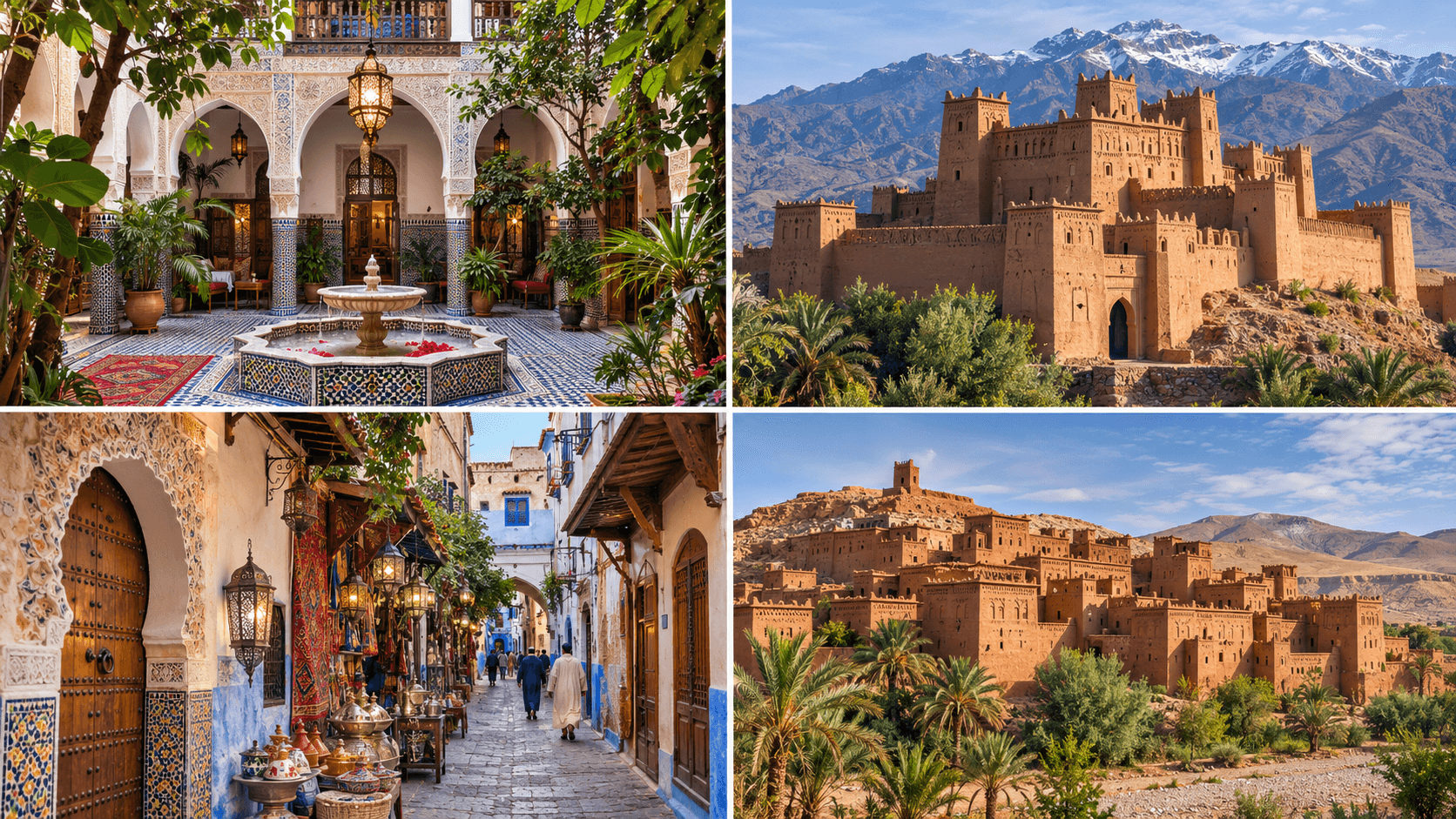
A riad is associated with a family house arranged around an interior garden courtyard. A kasbah is a fortified family residence, stronghold, or citadel, depending on the context. A medina is a historic urban center. A ksar is a fortified settlement containing multiple dwellings and shared spaces.
Understanding the riad vs kasbah distinction helps when choosing accommodation. Understanding medina vs ksar helps you recognize the scale and history of the places you visit.
The terms also fit together. You can stay in a riad within a medina, and a fortified settlement can contain substantial residences as well as smaller homes.
What Is a Riad?
A riad is a traditional Moroccan residential form organized around an interior garden courtyard. Rooms face this central space, which brings light and air into the house while creating privacy from the street.
The term is closely associated with a garden enclosed within a residence, as explained in the architectural glossary hosted by Archnet.
In larger historic examples, the courtyard may contain planted beds, trees, paths, and water features. The surrounding rooms and galleries create a strong connection between the house and its interior outdoor space.
That arrangement explains why a relatively plain entrance can open into an elaborate interior. Much of the architectural attention is directed toward the courtyard and the rooms around it.
What Features Might You See Inside?
Depending on the property, you may find geometric zellige tilework, carved plaster, timber ceilings, decorated doors, and a fountain. These materials and techniques form part of a broader Moroccan courtyard tradition, illustrated in the Metropolitan Museum of Art’s explanation of Moroccan courtyard architecture.
Their presence and quality vary. A fountain, swimming pool, roof terrace, or elaborate decoration is not guaranteed by the word “riad.”
What Does Riad Mean in a Hotel Listing?
In modern tourism, “riad” is used fairly broadly for accommodation inspired by traditional Moroccan courtyard houses. A listing may describe a restored historic residence, a substantially rebuilt property, or a newer building following a similar layout.
The name alone does not establish the building’s age, historical significance, or service standard.
Marrakech and Fes offer many opportunities to experience this style of accommodation. Before booking, look at the courtyard, room arrangement, access, and recent photographs. MSITravels’ guide to Moroccan riads provides additional context for choosing a property.
What Is a Kasbah?
A kasbah is a fortified place, but its scale and function depend on where the term is used.
In southern Morocco, it often describes a fortified residence or complex associated with a prominent family or local authority. In a city, it may refer to a citadel or fortified quarter containing multiple buildings.
That distinction matters. Describing every kasbah as an isolated earthen house in the desert leaves out important urban examples.
Kasbahs in Southern Morocco
Southern kasbahs are closely associated with earthen construction, including rammed earth and sun-dried brick. Their substantial walls and towers served defensive purposes while also enclosing domestic spaces.
Amridil in the Skoura palm grove is a useful example of this residential tradition. The Moroccan National Tourism Office’s Ouarzazate heritage guide describes its courtyard, towers, and internal organization.
A kasbah’s defensive appearance does not mean its decoration was necessarily simple. Some examples combine imposing exteriors with carefully worked geometric details and richly finished interior rooms.
Urban Kasbahs: A Different Scale
Rabat’s Kasbah of the Udayas, also spelled Oudayas, demonstrates the broader meaning of the term. Here, you are exploring a fortified historic quarter with streets and buildings, rather than a single rural residence.
UNESCO identifies the kasbah and medina as distinct components of Rabat’s historic urban heritage.
Urban examples also show why earthen construction is not a universal definition of a kasbah. Location, materials, layout, and later alterations vary.
What Does Kasbah Mean in an Accommodation Listing?
A kasbah hotel might occupy a restored historic structure, incorporate older sections, or use architecture inspired by regional fortified buildings.
Ask which description applies. If history is important to you, request information about the original building and its restoration. If comfort is the priority, ask about the room, heating, cooling, stairs, and vehicle access.
The word “kasbah” communicates an architectural association. It does not guarantee a particular level of luxury or a remote setting.
Riad vs Kasbah: The Practical Difference
A riad is principally understood through its inward-facing residential layout and garden courtyard. A kasbah is understood through its fortified character and historical role, which may involve a residence, stronghold, or urban citadel.
For travelers, a riad often provides a way to stay within a historic city neighborhood. A kasbah-style property may offer a different setting along a mountain or southern Morocco route.
However, neither label tells you everything about the experience. A riad can be lively, a kasbah hotel can be highly refined, and both can contain courtyards.
Choose the actual property and location that suit your trip.
What Is a Medina in Morocco?
In Moroccan travel usage, a medina is the historic urban center of a city or town.
It can include residential neighborhoods, markets, workshops, religious buildings, public spaces, and substantial private houses. A souk is a market within that wider urban environment.
Many Moroccan medinas have defensive walls and monumental gates. Narrow streets are common, but their layouts differ between cities. It would be misleading to describe a medina simply as an open settlement in contrast with a fortified ksar.
Fes and Marrakech: Two Different Examples
Fes offers a particularly rich introduction to historic urban life and architecture. Its medina contains residences, religious schools, mosques, fountains, and former merchant lodging buildings known as fondouks. These elements are described in UNESCO’s account of the Medina of Fez.
Marrakech has its own urban character, with historic neighborhoods, souks, gardens, major monuments, and Jemaa el-Fnaa. UNESCO’s description of the Medina of Marrakesh also identifies the city’s kasbah, showing how these architectural terms can appear within one city.
The experience of exploring a medina changes from street to street. Commercial lanes, residential passages, and major public spaces serve different purposes.
If you want help understanding those relationships, a guided exploration of Fes’s medina can provide more context than walking between landmarks alone.
Visiting a Medina Respectfully
Medinas remain places where people live and work. Keep entrances clear, ask before photographing residents or private workshops, and remember that an interesting doorway may belong to someone’s home.
Allow time to pause without treating every residential lane as a visitor attraction. A good guide can explain where access is appropriate and help you understand what you are seeing.
What Is a Ksar?
A ksar, with the plural commonly written ksour, is a fortified settlement.
The important idea is collective space: several dwellings and shared areas enclosed within a defensive arrangement. The Moroccan National Tourism Office’s architectural vocabulary guide describes a ksar as a walled village that can contain houses, kasbahs, and communal places.
Ksour are strongly associated with southern Morocco’s valleys and pre-Saharan regions. They should not automatically be imagined as isolated ruins surrounded by dunes.
Kasbah vs Ksar: Why the Distinction Needs Context
In southern Moroccan travel descriptions, comparing a fortified residence with a fortified settlement is a useful starting point.
However, “one family versus an entire village” is not a universal rule for every kasbah. An urban kasbah can be a substantial quarter.
The safest approach is to establish what the name refers to at the particular site: an individual building, a complex, a citadel, or a settlement.
Is Aït Ben Haddou a Kasbah or a Ksar?
Aït Ben Haddou is more precisely described as a ksar.
Its clustered dwellings and shared spaces sit within a fortified arrangement, with larger residences alongside more modest buildings. UNESCO lists it as the Ksar of Ait-Ben-Haddou and identifies it as an important example of southern Moroccan earthen architecture.
The site lies in the Ounila Valley, in Ouarzazate province, on the southern side of the High Atlas. Its historic setting is connected with trade routes through the region.
You will still encounter “Aït Ben Haddou kasbah” in tour descriptions and everyday travel language. Understanding the more precise term helps you recognize that you are exploring a settlement.
MSITravels’ Aït Ben Haddou tours can be considered when planning a route through this part of Morocco. Confirm the walking involved and current access arrangements before choosing your visit.
Medina vs Ksar: How Are They Different?
A medina describes a historic urban center, while a ksar describes a fortified settlement associated particularly with southern and pre-Saharan traditions.
Their buildings, streets, and public spaces developed in different local contexts. Both can have defensive walls, and both involve relationships between private homes and shared areas.
Atmosphere is a separate question. A medina is not always crowded, and a ksar is not necessarily deserted or silent. What you experience depends on the place, its current use, and when you visit.
The distinction is most useful for understanding settlement form and history. It is less useful as a promise about how busy or peaceful a visit will feel.
What Is a Dar, and How Is It Different From a Riad?
Dar means “house” in Arabic. It is a broader word than riad and appears frequently in Moroccan accommodation names.
In architectural discussions, a riad is particularly associated with an interior garden. A house called a dar may have a simpler courtyard arrangement.
Hospitality names are less precise. Properties use both terms in ways that do not always follow a strict architectural classification.
For booking purposes, “dar” is not a lower accommodation category, and “riad” is not an automatic sign of higher quality. A property’s name tells you much less than its layout, maintenance, hospitality, and location.
If you want a planted courtyard, a roof terrace, or rooms overlooking an open central space, check for those features directly.
What to Ask Before Booking a Riad or Kasbah Hotel
Understand the Building
Ask whether the property is historic, restored, substantially reconstructed, or newly built in a traditional style.
These are different descriptions, each compatible with a comfortable stay. Clear information helps you choose according to your interests.
For a riad, establish whether the courtyard is open to the sky, covered seasonally, or enclosed. Photographs taken at different times can make the same space look quite different.
Check Access and Room Location
For a medina stay, ask where the vehicle stops and how far you will walk to the entrance. Confirm luggage assistance rather than assuming it is included.
Inside the property, check the number of stairs, whether there is an elevator, and where your room sits in relation to the courtyard, kitchen, terrace, and common areas.
The same questions apply to kasbah-style hotels. An impressive exterior does not tell you how easy the building is to move around.
Confirm the Facilities You Need
Heating, cooling, bathroom arrangements, dining, and pool access should be checked individually.
If quiet matters, ask about the location of your room and how shared spaces are used. If you have mobility needs, describe them clearly and request specific answers about access.
These details will shape your stay more than the architectural label alone.
Planning a Morocco Trip Around Its Architecture
You can experience several of these traditions within one thoughtfully arranged journey.
A Marrakech stay can introduce you to a riad and its surrounding medina. A route across the High Atlas toward Ouarzazate can include Aït Ben Haddou and other examples of southern architecture. Depending on your wider plans, Rabat can add the different experience of an urban kasbah.
You do not need to include every term on a single holiday. Choose places that fit the time available and leave room to understand them.
MSITravels’ Morocco itinerary guide provides a starting point for discussing routes. The exact sequence should reflect your arrival point, interests, and preferred amount of driving.
Once you understand the vocabulary, an itinerary becomes easier to read. You can distinguish a place to stay from a neighborhood to explore, and a fortified residence from a wider settlement.
If you would like those experiences included in a journey, request a personalized Morocco itinerary. Share your interest in architecture alongside your practical needs, so the buildings you visit and the places you stay both contribute to an enjoyable trip.
MSITravels Team
Travel enthusiast and Morocco expert, sharing insights and stories from years of exploring Morocco's hidden gems and iconic destinations.
Ready to Explore Morocco?
Choose the experience that fits you best
Private Tour
A fully tailored Morocco experience crafted exclusively for you and your group.
View Private ToursSmall Group Tour
Join a curated group of like-minded travellers and discover Morocco together.
View Group ToursCustom Tour
Tell us your dream trip and we'll build a bespoke Morocco itinerary from scratch.
Tailor Your TourExplore More Stories
Discover more travel tips and inspiration for your Moroccan adventure
View All Articles